Friday, January 22, 2010

"Toward a New Perspective on Paul"


Before, we look at the main New Perspective writers; there is a preliminary scholar that should be discussed.  Kister Stendahl, in the 60’s was already looking critically at the interpretation of Paul.  Specifically, Stendahl noted that the problems Luther dealt with where not the primary issues for Paul.  Paul was interested in the relation of Jews and non-Jews.  For Stendahl the contrast is not “Christianity” and “Judaism” but “the law” and “the gospel.”

This shifts the way Paul’s conversion has been traditionally read.  Paul conversion was not from “Judaism” to “Christianity.”  Paul’s changed outlook was more in line with the calling of prophets, such as Isaiah and Jeremiah.  As Zetterholm notes “According to Stendahl, Paul serves the same God as before, admittedly in a different way, but still directly linked to what was already part of Jewish tradition” (99).  Paul’s theology then is understood as being in line with his own calling to be an apostle to the non-Jew.

“Justification,” for Stendahl is a part of the relation of Jew and Gentile, in Romans and Galatians.  “Justification” should be placed along side the center of the letter, mainly Romans 9-11.  This section deals with the God’s plan for final salvation and the relation of Paul’s ministry to the Gentiles, as a part of that plan.  Stendahl argues that God’s salvation plan anticipates the “no” of the Jews and opens to the Gentiles.  Salvation is for the Jews, as well, according to Stendahl, and he argues against a contradiction between salvation offered to Jews and non-Jews.  “Justification” then fits within this overall idea of God’s “victory” and “salvation” and that God’s righteousness will set everything right (99).

Stendahl’s writing points towards many of the ideas of recent scholarship and it is the overwhelming dominance of the traditional view, at the time, that made Stendahl’s ideas hard for many to understand.  It will be a short move from Stendahl to the next several scholars.

Monday, January 18, 2010

Normative theology, meet Biblical Studies


The last two posts have been some background for our discussion of the New Perspective on Paul as well as, areas of study that have moved beyond the NPP.  We have seen that several influences have led to the “traditional” or “standard” Lutheran view of Paul.  These influences come from Luther, Augustine, and other theologians and philosophers, like Hegel, as well.

The mixture of ideas created a view of Judaism as rejected by God and inferior to Christianity.  This way of thinking was widely assumed in the Post-Enlightenment period.  The theological assumptions remain intact, as the next group of scholars reconstructs history in light of theology.
Bultmann can be seen as the main influence for this final step of paradigm formation.  It is not Bultmann’s understanding of Paul but his marriage of Biblical Studies and Theology.  Bultmann was both an academic scholar and theologian, using each field to enlighten the other.

Ernst Kasemann was one of Bultmann’s disciples, although he broke from Bultmann’s interpretation, was influenced by his teacher.  Kasemann wanted to “build a bridge between the historical Jesus and the gospel of the early church” (78).  Kasemann saw Paul’s doctrine of justification coming from the teachings of Jesus.  It is this interconnected notion of the gospel of Jesus and justification that constitutes the issue for Kasemann. 

“The principle problem of Israel is not sin, Kasemann claims, but ‘pious works’…According to the doctrine of justification by faith, salvation is only possible for the lost and the damned - the ungodly – while the ‘good’ and the ‘pious’ imagine they can escape the impending judgment by means of their deeds” (80).  Kasemann’s view clearly rests on Reformation theology.  Even as we get into the New Perspective scholars, normative Christian theology will not change drastically.  Zetterholm sees this, the arguments over normative theology as the reason for so much of the debate amongst scholars and theologians.  The connection between normative theology and Biblical Studies, put forth by people like Bultmann and Kasemann, sets the tone for the next group of scholars and goes unquestioned until we look at those who have taken Paul beyond the New Perspective.

Wednesday, January 13, 2010

Zetterholm part 2

Yesterday, I introduced the book I will be going through this week and next week, “Approaches to Paul” by Zetterholm. In the last post, the foundation of the “traditional” view was laid. Today, we move into the theological explorations that marked the difference between Judaism and Christianity. This next step is, as Zetterholm points out, a construction of Christian theologians.

After working through the ancient sources that led to Christianities separation/distancing from Judaism, Zetterholm turns to Augustine, who will pave the way from Luther’s doctrine of grace. It is in response to Pelagius that Augustine developed his theology of sin and grace. Augustine emphasized the divine aspect of redemption against a human action. Divine intervention was necessary for both the ability and will to perform good deeds. As Zetterholm summarizes, “No human effort to please God is possible, which in the long run means that God decides who is to be saved and who is predestined to perdition” (59).

Luther would then start with the divine intervention, leaving the human action of good deeds to be result of grace. Righteousness is accessed through faith alone, a complete reversal of the Occamistic theology of the time (Which maintained that good deeds where met with grace leading to salvation). This left the Law in a very specific place, mainly for certain people at a certain time. Zetterholm points out,

“With Luther, the Law thus represents something good, in fact, the will of God, but its fulfillment is at the same time something unattainable. Anyone who imagines that he or she by means of the law can attain a relation to God is guilty of the of the most fundamental sin of all- self-righteousness- based on the false assumption that God can be pleased through human effort. For such a person, the law does not lead to grace and forgiveness, but to punishment and damnation” (61).

This theological formation with the Hegelian evolutionary process puts Judaism in a terrible place. Luther’s theology meant a complete rejection of Judaism. Zetterholm stress that Luther was not reading Paul for historical reconstruction, but to address theological issues. Luther’s formulation was a Christian theological construction. It will be the later Biblical scholars that apply this reading to their reconstructions of Paul. In the next couple of days, we will look at Zetterholm’s third chapter, “The Formation of a Standard View.”

Tuesday, January 12, 2010

"Approaches to Paul"


I thought I would go through a book this week and in to next week.  Over the Christmas break, I had dinner with a friend, who works in a church but not heavily into Biblical studies.  Over dinner, he asked me to explain the New Perspective on Paul.  He had heard about it at church and in the Christian media.  So, along that line I thought I would go through Magnus Zetterholm’s “Approaches to Paul: A Student’s Guide to Recent Scholarship.”

Zetterholm does an exceptional job of over viewing the history and current trends in the study of Paul by analyzing the major works that have contributed to Pauline scholarship.  He broadly lays out three main groupings, the standard view, new perspective, and beyond the new perspective.  These form the main portion of his work with some introductory and concluding chapters.

I wanted to skip the first chapter, which is a history of Paul and his missions, and jump into what has lead to the necessity for a new perspective on Paul.  Zetterholm begins with the Tubingen School and the influence of Hegel.  Hegel’s philosophy, in many ways, and was understood as open theology back up in light of the Enlightenment.  Hegel’s understanding of reality functioned in a process.  Each generation gives rise to a higher ordered understanding, followed by another even higher understanding.  This view sees the past as “a lower evolutionary form than the present, and the future always holds something better in store.  The reason for this s that the dialectical process is not governed by chance…The history of the world is thus a process run by reason, which in reality is the true lord of the world” (34).

This influenced the way Biblical scholars viewed Judaism, mostly in theological terms.  Zetterholm notes the work of F.C. Baur who was influenced by Hegel and the Tubingen School.  In Baur’s writing of history, Paul argues against Judaism.  Paul represents a later, higher understanding than earlier Judaism.  With Hegel’s ideas in mind, it is easy to see how this can lead to anti-Semitic notions of Judaism.  Zetterholm draws on the historical nature of anti-Semitism in Christian communities, noting that distinctions where made between Jews and Christians from an early point in Christian history.

It is with this background that Zetterholm discusses the nature of Luther’s writings, as well as Augustine.  Which we will turn to next time.

Thursday, January 07, 2010

Religion verses Relations


I recently was reading a friends blog about her experience in Africa.  This post was dealing with the nature of the church in Africa that brought up some ideas on which I wanted to comment.  She was frustrated with a range of things, many of which are frustrations I share.  The biggest was the popularity of “Prosperity Gospels,” which was recently spoken of as the worst religious idea of this decade in The Washington Post.

However, amidst the frustrations of locals becoming pastors, orphanage caretakers, or teachers so that they have a steady job that can pay, the real frustration was that Africans struggle with understanding Christianity as a relationship and not a religion.  I think this is the wrong way view Christianity.  The religion/relationship dichotomy fails to see the function of religion/s.  Marx’s definition of religion serves as an example of this unintelligent reasoning.  Marx’s states that religion is the opium of the masses, so the relational Christian states, “Marx’s maybe be right but it does not matter because Christianity is not a religion, it is a relationship.”  In short, it turns into a way of sidestepping the harder question of the function and meaning in religion, in spite of definitions like Marx, Freud, Fuerbach, and others.

Christianity is a religion.  It constructs a world-view that orders and makes sense of the world around the individual.  It provides rituals, sacraments, and a liturgy to reinforce this understanding of the world.  But what is bad about this?  All world-views do this. 

When applied to many African communities, this dichotomy is often to initially misunderstood.  To the Westerners, it seem as though the Africans do get it.  That’s right, they don’t.  They did not get the Enlightenment hammered into their heads from grade school.  They did not group up with spirituality and physicality completely separated.  That is our inheritance.  We make the distinction between religion/relations and spirituality/physicality.  Spirituality is a part of physicality for them.  They are in relationship with their religion.  So of course, they “don’t get it.”  The spiritual realm is in relationship with the everyday.  That is why the “Prosperity Gospel” is appealing.  That is why the everyday notions of religion are just that, everyday notions.  This is an area where we should be learning from each other.  Not simply imposing the Western understanding and getting upset because they are not “doing it” the way we do.  In many ways, we could use some physicality in our spirituality.

Wednesday, December 30, 2009

Music from 2009

In light of it being the final week of 2009, I thought I would post some of my favorite albums from this last year.  I don't think I bought enough music this year to make a complete Top 10 list, so here are a few albums that got played regularly around the house, car, and coffee shops I haunt.

"Hazards of Love" the Decemberists
This was a surprisingly great album.  I had heard the single, The Rake's Song, at work before it came out and it peeked my interest.  It is a concept album, following a love story, that displays the wide range of the Decemberists musical abilities.  I am a huge fan of the organ, and this album has some great rockin' organ parts, The Queen's Rebuke is one of the best songs off the album.  The Decemberists do a great job with the electric folk style.  Much more rock-n-roll than the Fleet Foxes and the other newer folk out there.  The album is distinctly the Decemberists but a divergence from The Crane Wife, their previous release.  Overall, the entire album is worth checking out.

"Curse Your Branches" David Bazan
I picked up this album right before seeing Bazan perform in SF.   The concert was the best show I saw this year.  I have seen Bazan several times in the last few years and the shows are consistently good, usually just David playing by himself.  But after releasing the album he did a string of shows with a full band.  The album has the common traits of Bazan with a band fit to back him up.  This made the show a lively mix of older Pedro songs and his newer songs.  It was good to hear Bazan play with a full band, and some of the Pedro the Lion classic songs.  This album is a testament to the struggle Bazan has had in the last few years and his ability to create great music in light of all circumstances.

"Popular Mechanics"  Surrogate
I got to listen to several of the demos from this album and was impressed by them.  So, when the album came out over the summer I had a rough sense of what it would be like.  As with the other albums, the finished product was a bit unexpected.  It is a well crafted album, in both writing and playing.  The move from recording in a warehouse to a studio helped give the album a more polished sound.  And this is accented by Chris's witty and humorous lyrics.  This album fits within the genre of my other picks and my current interests are clear in my choices.  But again each album in one way or another surprised me.  We will see what comes out in the next year...

Monday, December 07, 2009

A Break From Writing...

Currently, I am spending all my time writing papers for the end of the semester (I can't wait!).  Right now I am going through James C Scott's idea of hidden transcripts as modes of resistance.  These are not outright resistance movements but everyday ways that oppression is felt.  This made me think about everyday ways people today could resist many of the negative forces at work that create injustice around us.

These injustices become more apparent as the holiday's draw near.  I would not be opposed to the outright rejection of many traditions around the Christmas holiday, such as the grossly exaggerated need to decorate ones house in little flashing lights.  But that will only lead to my being labeled a "grinch."  If that has not already happened.  So, with the spirit of giving, here are some ideas that give more than just a reason for your neighbors to call the cops because everyone in town has to see the monstrosity that is your holiday decorated home.


1. TOMs These shoes are great.  I am a huge fan of my TOMs, they are on par with my Rainbow sandles. For each pair of TOMs you buy, they donate a pair to a child in need of shoes.  Its a simple idea, that works.  Plus TOMs are comfortable and they have enough designs that you could get a pair for nearly anyone.  This year they started making a pair that ties, as opposed to their traditional slip-ons.  I really like the new design.  And like my small group guys like to say, "Nice shoes, are those like a requirement to go to Berkeley?"  www.toms.com

2.  (timbuk2)Red messenger bag  Again, Timbuk2 is a company I really like.  I have had several of their bags and they are top notch.  Right now I have my Timbuk2 backpack with me and it seriously carries a significant portion of my library with room to spare.  I have taken my Timbuk2 bag(s) with me everywhere I have traveled.  Well, this year they partnered with (product)Red and designed a new bag.  Its similar to their regular messenger bags but with a new feature.  They put a special cam buckle on the bag so you don't have to loosen the strap to get the bag off.  All you do is unbuckle it!  As with other (product)Red goodies a portion of the cost goes to the Global Fund to combat AIDs in Africa.


Here are just 2 great ideas out of many ways you can turn the consumer holiday of Christmas into something more.  But if you want to really want to go big and give a revolutionary gift, buy some goats for people in need ($75 www.worldvision.org).  Its amazing what a goat can do for a family.  Let's be people who challenge the hidden transcripts that tell us that the world is about us.

Tuesday, December 01, 2009

World AIDs Day

At the request of my sister, I thought I would offer some thoughts from my experiences abroad.  I should point out that for me thoughts are directly related to our actions in the world.  How we think, is directly related to how we act and interact with others.  So, I hope these thoughts can spur some conversation, that leads all of us to be involved somehow.

This last summer, I was in South Africa for a gathering of church leaders from the African continent.  This was a chance for people to discuss the nature of the church in Africa and dream of ways that Africa can enrich the global church.  This can be both encouraging and tiring as one wrestles with where we are (in the now) and where we would like to be (in the future).  Sometimes this divide seems to great.  But that is the tension.

While I was there, I had the chance to visit a development project in Swaziland.  Swaziland has one of the highest AIDs rates in the world, if not the highest.  The Population Reference Bureau charted it at 33.4% in 2006, being the highest rate in the world.  Groups like World Vision are working hard to help the country deal with this epidemic (Almost half the population receives help from World Vision).


What surprised me was not the numbers, which are staggering enough.  But the type of work that World Vision was doing.  One of the biggest projects was training church and communities leaders in the nature of AIDs.  Many people where living under stigma that people with AIDs where disloyal, promiscuous, or amoral in some way.  This was a view that the Swazi's heard in church, school, and from aid groups (like USAID pictured above).  This stigma ruined peoples lives.  Having sex with a virgin was a widely viewed supposed cure.  Which led to the rape and continued prevalence of AIDs.  People where scared to check, which was an issue we ran into in Uganda.

World Vision is working to teach leaders healthy was of viewing the AIDs and those affected by it.  By dismantling the stigma, people where able to talk about AIDs and move forward.  This made me reflect on our own situation in the US.  What mythic views are we teaching and practicing?  What stigma do we have around AIDs, or heart disease, or any other medical issue?

As we stop to reflect on the affect of AIDs on our world, we must reflect also, on humanity.  This not an issue for "others" as if we can let someone else come up with solution.  We suffer when we ostracize our brothers and sisters.  The AIDs community has had to deal with the pain of not only the disease but of being pushed to the margins of their communities.

I will post more on how this relates Christian communities especially, as well as, ways of engaging our communities.  I think there are amazing things being done by groups like World Vision.  They continue to be a hope in places with little perceived hope.  We can learn a lot from groups like this.

Friday, November 27, 2009

BS and Monty Python

As I commented earlier, I heard several people this last weekend quote Monty Python's "Life of Brain" movie.  I have no problem with this, in fact I was quite a big Monty Python fan in Jr. High.  But it was ironic that a joke made in that movie became the theme for several discussions on the interplay between Jewish and Christian communities under the Roman Empire in the first century.

In the last couple decades the common stance has been to see the early Christians as anti-imperial.  They sought to create the Kingdom of God as an opposing force to the Kingdom of Caesar.  This was a healthy move for Biblical Studies noting the many ways the biblical writers undermined the culture around them.  This view continues today, a whole slew of books look at the anti-imperial nature of the gospels and Paul's writing.  The question raised in Life of Brain is "What have the Romans ever done for us?"

This is a valid question, the answer that many of these early Bible and empire professors have given is "only a model of what not to do."  As if the Roman Empire only stood as the great antithesis to Christianity.  Which is partially true, the Roman Empire was antithetical towards the Kingdom of God but it also stood as a great model of organized structure, military technology, and sovereign ruling.  All these aspects are drawn out in the New Testament writings, look at John and Paul for many features of Roman understanding.  So, while the New Testament presents a competing kingdom to Roman, it also barrows from Roman life to design, share, and display this kingdom.  I'm looking forward to tracing more of the influences, both good and bad, of Rome on the first Christians.  This will also help us understand the complexities of life today, which is still plagued with the mix of influences from American politics, global economics, and contemporary Christianity, just to name a few.

Sunday, November 22, 2009

Who has two thumbs and likes books?

This guy.  Thats right, I enjoy reading.  Which is usually not a problem.  It doesn't endanger my health and rarely is it the direct cause of suffering in my reality.  But it does cause some serious dilemmas.  Like my current situation.

I am at an annual meeting for nerds like myself, and there are a lot of them.  The Exhibition Hall is filled with books at extreme low prices.  Hence, the dilemma: do I spend my money on books? Or do I enjoy the city on New Orleans and go out to dinner?

Yup, you guessed it.  I'll go for the books.  Here are some recent titles that I am looking at, or that have come up in conversations here.  These are books that have to do with my area of concentration and will hopefully spark some MA Thesis ideas:

Warren Cater The Roman Empire and the New Testament : An Essential Guide. 
James C Scott Domination and the Arts of Resistance: Hidden Transcripts.
Simon Price Religions of Rome.


I will have to post some of the other interesting titles that come up in some of my other areas of interest, like Paul.  There are some great conversations going on here.  We will see what comes of these papers.  Maybe a few more books...


P.S. I have heard the line from Monty Pythons "Life of Brain," "What have the Romans ever done for us?" quoted four times in papers so far.

Saturday, November 21, 2009

Branches in New Orleans

Currently I am spending vast amounts of time listening to some very smart people, and a few who like to think they are very smart, discuss their recent scholarship.  This morning I heard a great take on Paul's use of the olive tree metaphor.  The passage in Romans, mainly 11.24, speaks of wild olive branches being grafted into a natural tree.  The issue was brought by Mark Nanos that the verse is commonly translated as "broken off" or "cut off" as in the branches are completely removed.  This runs contrary to agricultural practice, which Mark went into from 1st c. sources, and helps form a misunderstanding of the argument Paul is making.  Now, Paul is not farmer and his metaphor does not work in actual tree pruning.  But  that is not the point.

The point Paul is stating is the state of Gentile converts.  Not the state of Israel, which is referenced as the branches that are "broken off."  Paul is commenting on inclusion of Gentiles into the tree, which is Israel in Christ.  Paul does not go into the state of "Jews," "Judaism," "Israel," in modern terms, as one single group, but continues his thought that salvation has come to all through the Christ event, rendering the church the Israel in Christ.  I was challenged by the argument to reconsider the role of the olive tree metaphor in Paul.  I think many of the older ideas about Paul's view of Israel, and Jews, are often not looked at close enough, and are simply brushed over with only a note about Paul's opposition to Judaism.  We cannot disregard the multiplicity of understandings, ideas, and meanings as to what it meant to be a first century Jew.  Modernity cannot be projected back on to the first century.

Well, I'm off to yet another session.  I'm sure much more will come up as the conference continues.  And a lot of books are being added to "the list."

Tuesday, November 17, 2009

Emerging Leadership Needs in the PC(USA)

So, I attended a discussion of leadership needs in the Presbyterian church with the Presidents of every seminary.  It was an interesting night with lots of big talk, of bold action in the future of the PC(USA).  This was good to hear but not very deep.

The discussion quickly turned to the usual debate of "others."  Personally, this is a waste of time.  There is no point in trying to hash out a a definition of "multiculturalism" and trace the history of the word.  People today are more aware of the differences in the people around them.  The subjectivity of human experience leads many to the recognition of value in all of humanity.  The debate then over multiculturalism is not an issue.  The issue is the old white guys, a.k.a. presidents of PC(USA) seminaries, coming up with agreeable way of talking about changes they cannot stop or slow.  The PC(USA) is losing people for a number of reasons but "multiculturalism" is not one of the reasons.  It is a characteristic of the church.

In the midst of the attempt at defining a Presbyterian way of dealing with "multiculturalism," the President of Princeton Theological Seminary remarked, "I am a Brit and we are dealing multiculturalism in a different way.  We do not have the shameful past that you do."  WHAT? The British don't have a shameful past of slavery and colonialism? This blew me away.  The President of Princeton Theological Seminary was disregarding his own countries history to point out that multiculturalism an issue for Americans not for the British.

The biggest issue with the discussion was that it was trying to come up with a way of talking about "others." And not finding ways to draw them into the church.  As long as there is an us/them nature to the way Christians talk, people will be pushed away.  PC(USA) must update itself, and this can talk many forms but, at the heart the Presbyterian church, and many other churches, must be a way of speaking to the situations in which people live.  We must recognize the humanity of all and build our churches, and leaders, to address the needs of humanity.

Tuesday, October 27, 2009

"Reading Week"

So, it has been a little while since I have posted anything.  I have been a little busy and not reading Moltmann as much as I would like.  However, I have been riding regularly.  Which is a favorite past time.

This week I writing a couple of papers for class.  As soon as I finish these I will get back to The Way of Jesus Christ.  As well as, some of the other readings and thoughts from my course work.

Tuesday, October 13, 2009

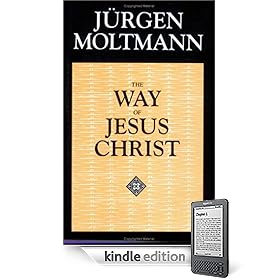
Moltmann Does It Again!

Moltmann, in The Way of Jesus Christ, to outline a "christology in the eschatological history of God" (70). But first he clarifies what he means by the "eschatological history of God."  He does this by setting the opposition of the history of progress, against eschatological history.

For Moltmann, this opposition (contradictions in his terms) are seen as the modern challenges to Christian theology.  Christian theology is challenged by three questions, using Bonhoeffer's formulation: Who really is Christ for us today? With underlying question of who are we today?  The first aspect of modern life which challenges theology is the development of the Third World.  And the rising inequities and injustices that come from the First and Third World divide.  The first question is then, Who really is Christ for the poor of the Third World? And: Who is the Christ for us, when we make use of their poverty for our own purposes? (65).  This gives way to the rise of nuclear power.  Moltmann points out the desire to be a world power and it connectedness with nuclear weapons.  For developing countries, nuclear weapons becomes the mark of "making it."  This, however, creates the fear of annihilation.  Therefore the second challenges is: Who really is Christ for us today, threatened as we are by the nuclear inferno?  The final aspect is the degradation of the natural world.  We have become more aware of our own immortality in the face of environmental challenges.  Thus, the final challenge: Who really is Christ for dying nature and ourselves today?

Moltmann's christology looks to the history of God, that is in opposition to the challenges faced in contemporary society, as seen in the questions of who Christ is for us today.  Challenging and insightful, once again I see great hope in the churches role in response to these challenges.

Sunday, October 11, 2009

Moltmann, "The Way of Jesus Christ"


I started reading Jurgen Moltmann's "The Way of Jesus Christ,"  It has been interesting getting into his idea of a christology that is connected to eschatology.  Of which I am sure I will talk more about as I get deeper into the book.  What really stood out to me was this quote:

The End-time condition of world history today requires us to see the real misery of human beings as one with the growing universal misery of the earth.  The deadly fear men and women are experiencing is fear of nuclear catastrophe in the present, and ecological catastrophe in the future, and the conflicts in social and economic life which are the result of both.  What was once presented as the general and timeless metaphysical wretchedness of human beings is now returning in the special form of the human miseries of the End-time... The antinomies of modern civilization are drawing human beings and nature deeper and deeper into a common destiny.  This forbids any reduction of salvation, whether personal or anthropological.  In the danger of annihilation that is hanging over us, God's salvation is the healing and survival of the whole threatened earth and all individual created beings, in their common peril (45-46).


I was really taken by the insight into the issues today.  By no means has the fear of nuclear annihilation gone away but, the ecological crisis has come to the forefront of social concern for many.  This view of humanity and nature being driven to a "common destiny" is becoming more and more apparent, many times outside of the church.  The impact of thoughts like this has the potential to enliven the church in a fresh new way, as is already at work in many communities.  Another reason why more people should be reading and engaging theologians like Moltmann.  I cannot wait to hear more about his talks at the 2009 Emergent Village Theological Conversation.

Tuesday, October 06, 2009

Happy Birthday Me!

So, it was my birthday on Friday and to celebrate I spent the weekend helping out the high school group on a Water Ski Weekend.  Now, I love being on the water and skiing is a favorite activity of mine.  That being said I was pretty excited to hang out on the Lake all day and maybe get a run or two in.

Friday night we arrived at the Lake and set up camp.  The leaders surprised me with a cake and singing, which was great.  Saturday morning some of us where up early and decided to go out on the water, most of us would be driving the rest of the day so this would be chance to ski.  I was pretty excited to ski, despite cold water and the early time.  Anyways, I was picked to go first and the run started out great.  As I was skiing I cut across the wake and the ski jumped a little throwing me off balance.  I hit the water pretty hard but felt OK.  I got back up and had a great rest of the run.  When I got back into the boat, they asked what happened?  I said when.  And they responded that my face was swollen.  I had given myself a black eye when I fell.  Needless to say that was the first time I had given myself a black eye.  Happy birthday to myself.  Now I look like I got punched in the face.  Which could be a good thing...

Monday, September 28, 2009

It's Been A Long Time...

I know it has been a while since I have posted anything here.  And I meant to use this as a travel journal.  But that never panned out and I kind of forgot about this blog for some time.  Well, being that I have moved, changed schools, and a host of other things have changed I figured it would be worth it to update this place a bit.  Hopefully I will do a better job keeping up the blog.

That being said, I have had several people ask about my current studies and living situation.  I just started my Master of Arts in Biblical Studies at the Graduate Theological Union in wonderful Berkeley, CA.  That's the exciting part.  The not so exciting part is that I moved back in with my parents and have joined the untold numbers of college graduates living at home with their parents.  I am looking to remedy this soon.  Anyway, like I said I am hoping to update this more often with travels, studies, and anything else I find of note to post here.